Life can feel a lot like driving a car. Car metaphors for life use roads, steering wheels, brakes, fuel, traffic, and destinations to describe choices, struggles, growth, relationships, and personal goals. People search for these metaphors when they want a simple way to explain a complicated feeling or life lesson. You may see them in everyday conversations, motivational speeches, books, social media captions, classroom writing, and personal messages. The best ones work because almost everyone understands what it means to stop, turn, speed up, or change direction. This guide, explains the meaning behind these expressions and gives practical examples you can actually use. You will also find examples for casual speech, professional writing, and thoughtful personal messages.
What Are Car Metaphors for Life?
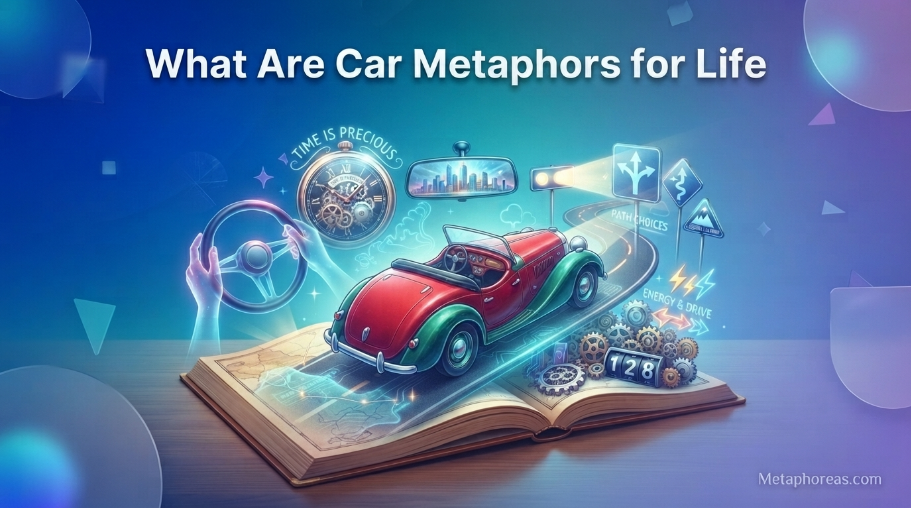
Car metaphors for life compare parts of driving—such as roads, fuel, brakes, steering, traffic, and destinations—to real experiences in life. They make abstract ideas easier to understand by connecting them to familiar situations, such as making choices, facing setbacks, reaching goals, or changing direction.
A car gives us a useful picture of how life can work. You choose a direction, deal with unexpected problems, decide when to stop, and keep moving toward something that matters.
These expressions are metaphors, not literal statements. If someone says, “Life is a highway,” they are not saying that life is an actual road. They are comparing the journey of living to the experience of traveling.
| Car image | Life idea |
|---|---|
| Steering wheel | Making choices |
| Road | Life journey |
| Destination | Goal or purpose |
| Fuel | Energy or motivation |
| Brakes | Rest or self-control |
| Traffic | Delays and obstacles |
| Detour | Unexpected change |
| Rearview mirror | Looking at the past |
| Headlights | Planning for the future |
| Passenger | Someone sharing your journey |
Why We Use Car Metaphors for Life
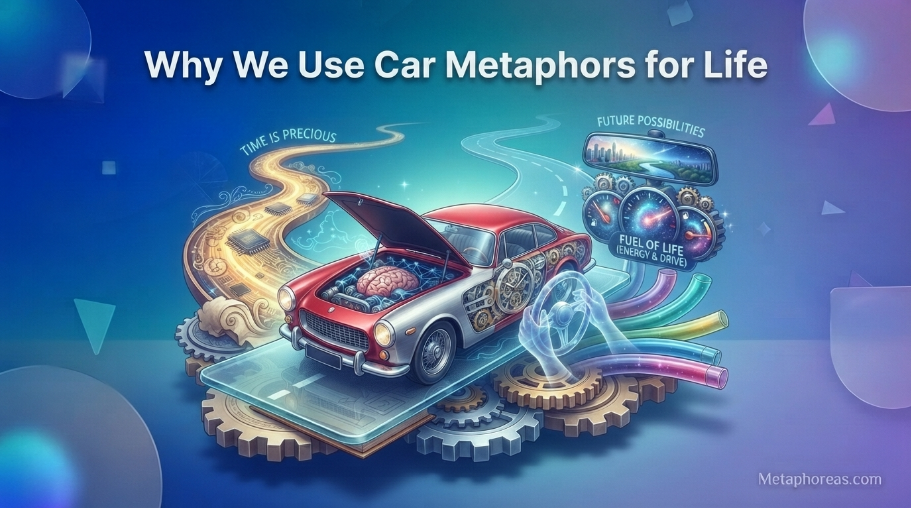
Car metaphors give people a quick way to talk about experiences that can otherwise be difficult to explain.
Instead of saying, “I need to rethink my current direction,” someone might say, “I need to change lanes.” The second version creates an instant picture.
These expressions are useful in:
- Everyday speech: “I think we need to slow down.”
- Personal writing: “I took a wrong turn, but I found another road.”
- Speeches: “You are the driver of your own life.”
- Social media: “Some roads are meant to be left behind.”
- Work conversations: “We need to change direction.”
- Stories and poems: Cars and roads can represent growth, freedom, fear, or change.
They also make advice feel less like a lecture. A simple image can communicate a lesson without using complicated language.
1. Life is a journey
This metaphor compares living to traveling from one place to another. It suggests that experiences, choices, and changes shape the trip.
Example: “Life is a journey, so I am learning to enjoy the road.”
Tone: Neutral
2. You are in the driver’s seat
Being in the driver’s seat means taking responsibility for your choices instead of letting other people control your direction.
Example: “You may not control everything, but you are still in the driver’s seat.”
Tone: Informal
3. Change lanes
Changing lanes represents changing your approach, career, relationship, routine, or general direction.
Example: “My old career was not working, so I decided to change lanes.”
Tone: Neutral
4. Life is a highway
This classic expression presents life as a long road filled with different places, people, choices, and experiences.
Example: “Life is a highway, and every mile teaches you something.”
Tone: Neutral
5. Take the wheel
Taking the wheel means taking control and making your own decisions.
Example: “It is time to take the wheel and decide what you really want.”
Tone: Informal
6. Put the brakes on
Putting the brakes on something means slowing down or stopping before moving forward.
Example: “I had to put the brakes on my spending and rethink my budget.”
Tone: Informal
7. Step on the gas
This metaphor means increasing effort, speed, or determination.
Example: “The deadline is close, so we need to step on the gas.”
Tone: Informal
8. Running on empty
Running on empty describes a person who has little physical or emotional energy left.
Example: “After weeks of work without rest, I was running on empty.”
Tone: Informal
9. Refuel yourself
Refueling represents resting, recovering, and getting your energy back.
Example: “A quiet weekend helped me refuel before starting my next project.”
Tone: Neutral
10. Hit a roadblock
A roadblock represents a problem that prevents progress.
Example: “We hit a roadblock when the funding disappeared.”
Tone: Neutral
11. Take a detour
A detour represents an unexpected change that takes you away from your original plan.
Example: “Losing that job was a detour, not the end of my career.”
Tone: Neutral
12. Take a wrong turn
A wrong turn represents a poor decision or direction that leads somewhere you did not intend to go.
Example: “I took a wrong turn, but the experience taught me what I really wanted.”
Tone: Neutral
13. Get back on the road
This metaphor describes returning to progress after a setback or difficult period.
Example: “After the breakup, she slowly got back on the road.”
Tone: Informal
14. Keep moving forward
The road image here represents continued progress despite difficulties.
Example: “The past was painful, but I chose to keep moving forward.”
Tone: Neutral
15. Look in the rearview mirror
The rearview mirror represents the past. Looking at it suggests reflecting on previous experiences.
Example: “It is useful to look in the rearview mirror, but you cannot drive forward that way.”
Tone: Neutral
16. Do not live in the rearview mirror
This expression warns against becoming trapped by past mistakes, regrets, or memories.
Example: “Learn from yesterday, but do not live in the rearview mirror.”
Tone: Informal
17. Follow your own road
Your own road represents an individual path rather than one chosen by other people.
Example: “My family wanted a different career for me, but I decided to follow my own road.”
Tone: Neutral
18. Reach your destination
A destination represents a goal, achievement, or desired result.
Example: “The road was difficult, but she finally reached her destination.”
Tone: Neutral
19. Lose your direction
Losing direction means becoming unsure about what you want or where your life is going.
Example: “After college, I felt like I had lost my direction.”
Tone: Neutral
20. Find your way
Finding your way means discovering a suitable path after uncertainty or confusion.
Example: “I did not have all the answers, but I trusted myself to find my way.”
Tone: Neutral
21. Life has traffic
Traffic can represent delays, distractions, pressure, or problems that slow progress.
Example: “My plans are moving slowly because life has been full of traffic lately.”
Tone: Informal
22. Watch the road ahead
The road ahead represents the future and the choices that have not yet happened.
Example: “Learn from the past, but keep watching the road ahead.”
Tone: Neutral
23. Turn the headlights on
Headlights represent awareness, preparation, or guidance when the future is unclear.
Example: “When the next step feels uncertain, turn your headlights on and move carefully.”
Tone: Neutral
24. Stay in your lane
Staying in your lane means focusing on your own responsibilities instead of interfering with someone else’s life.
Example: “You do not need to compare yourself with everyone else. Stay in your lane.”
Tone: Informal
25. Change direction
Changing direction means choosing a new goal, plan, or path.
Example: “After several failed attempts, we changed direction.”
Tone: Neutral
26. Enjoy the ride
Enjoying the ride means appreciating the present instead of thinking only about the final goal.
Example: “Work toward your dreams, but remember to enjoy the ride.”
Tone: Informal
27. Choose your passengers wisely
Passengers represent the people we allow to influence or accompany us through life.
Example: “Choose your passengers wisely because the people around you can affect your journey.”
Tone: Neutral
Quick Reference Table
| Car metaphor | Meaning | Tone |
|---|---|---|
| Life is a journey | Life is a path of experiences | Neutral |
| In the driver’s seat | In control of choices | Informal |
| Change lanes | Change direction or approach | Neutral |
| Life is a highway | Life is a long journey | Neutral |
| Take the wheel | Take control | Informal |
| Put the brakes on | Slow down or stop | Informal |
| Step on the gas | Increase effort | Informal |
| Running on empty | Having little energy | Informal |
| Refuel yourself | Rest and recover | Neutral |
| Hit a roadblock | Face an obstacle | Neutral |
| Take a detour | Follow an unexpected path | Neutral |
| Take a wrong turn | Make a poor choice | Neutral |
| Get back on the road | Resume progress | Informal |
| Keep moving forward | Continue despite problems | Neutral |
| Look in the rearview mirror | Reflect on the past | Neutral |
| Do not live in the rearview mirror | Do not stay trapped in the past | Informal |
| Follow your own road | Choose your own path | Neutral |
| Reach your destination | Achieve a goal | Neutral |
| Lose your direction | Become uncertain | Neutral |
| Find your way | Discover a path forward | Neutral |
| Life has traffic | Experience delays or problems | Informal |
| Watch the road ahead | Focus on the future | Neutral |
| Turn the headlights on | Prepare for uncertainty | Neutral |
| Stay in your lane | Focus on your own path | Informal |
| Change direction | Choose a new path | Neutral |
| Enjoy the ride | Appreciate the journey | Informal |
| Choose your passengers wisely | Choose your influences carefully | Neutral |
Car Metaphors in Real-Life Conversation
Casual conversation
Maya: “You seem stressed lately. Everything okay?”
Jordan: “I have too much going on. I feel like I am running on empty.”
Maya: “Then maybe put the brakes on for a few days.”
Jordan: “I know. I keep thinking I have to keep moving.”
Maya: “You can slow down without giving up. You still control the wheel.”
The conversation sounds natural because the car images match the feelings without requiring a long explanation.
Professional conversation
Manager: “The original plan is not producing the results we expected.”
Daniel: “Should we change direction?”
Manager: “Yes. I think we need to take a detour and test another approach.”
Daniel: “That makes sense. We can keep the main goal but use a different route.”
Here, the metaphors make a workplace discussion about change sound clear and approachable.
How These Metaphors Appear in Everyday Life
Car and road expressions are especially common because driving is part of everyday American life. People often use them without thinking about the original comparison.
In text messages, a friend might write, “I am running on empty,” to explain exhaustion without giving a long story.
On Instagram, expressions such as “Enjoy the ride” or “Follow your own road” work well as short captions because they connect a simple image with a personal message.
In conversation, people use phrases such as “take the wheel,” “change lanes,” and “hit a roadblock” as ordinary expressions. The metaphor becomes so familiar that listeners understand it almost instantly.
In professional settings, road language can also make difficult changes easier to discuss. A team can “change direction,” “remove a roadblock,” or “find another route” without making the conversation sound overly formal.
Common Mistakes
| Mistake | Reason | Correct Version |
|---|---|---|
| “I am in the driver seat.” | The usual expression includes the article. | “I am in the driver’s seat.” |
| “I am running on an empty.” | “Empty” is used without an article here. | “I am running on empty.” |
| “We hit on a roadblock.” | The expression does not use “on.” | “We hit a roadblock.” |
| “I took a detouring.” | The noun “detour” is the natural form. | “I took a detour.” |
| “Stay on your lane.” | The standard phrase uses “in.” | “Stay in your lane.” |
| “I changed the lane in life.” | This sounds overly literal. | “I changed lanes in life.” |
| “Look at the rearview mirror.” | The natural expression uses “in.” | “Look in the rearview mirror.” |
Related Terms
Car metaphors for life overlap with other forms of figurative language, but they are not exactly the same.
| Related concept | Main idea | Difference |
|---|---|---|
| Journey metaphors | Life as travel | Broader; may use trains, paths, boats, or walking |
| Road metaphors | Life as a road | Focuses mainly on routes, turns, obstacles, and destinations |
| Vehicle symbolism | A vehicle represents an idea or character | Often appears in stories, films, and literature |
| Life metaphors | One thing represents another part of life | Much broader than car-related comparisons |
A car metaphor is therefore one specific type of life metaphor. It becomes especially effective when the writer wants to show control, speed, direction, obstacles, or movement.
Frequently Asked Questions
What is the best car metaphor for life?
One of the clearest is “You are in the driver’s seat.” It suggests personal responsibility and choice. You may not control the road, weather, or other drivers, but you can still make decisions about how you respond and where you go.
What does “life is a highway” mean?
“Life is a highway” compares life to a long trip with many stages and experiences. The phrase can suggest freedom, uncertainty, movement, and change. It does not mean every part of life will be easy; like a real highway, the journey can include traffic, unexpected turns, and rough conditions.
What does a car symbolize in literature?
A car can symbolize freedom, independence, status, escape, control, or movement. Its meaning depends on the story. For one character, driving may represent freedom. For another, a broken-down car might represent being trapped or unable to move forward.
Is “life is a journey” a metaphor?
Yes. “Life is a journey” is a conceptual metaphor because it describes life through the familiar idea of traveling from one point to another. Goals become destinations, difficult periods can become obstacles, and major decisions can become turns or changes in direction.
Can car metaphors be used in formal writing?
Yes, but choose them carefully. Expressions such as “change direction,” “reach a destination,” and “roadblock” can work well in professional writing because they are widely understood. Very casual phrases such as “step on the gas” may sound less suitable in a formal report.
What is a metaphor for changing your life?
“Changing lanes” is a strong metaphor for changing your life because it suggests moving from one path to another while continuing the same overall journey. It works especially well for career changes, new routines, fresh goals, or major personal decisions.
What is a metaphor for overcoming obstacles?
“Getting around a roadblock” is a useful metaphor for overcoming an obstacle. It suggests that a problem does not always require giving up. Sometimes you need another route, a new strategy, or more time before you can continue.
Can I use these metaphors in a speech or caption?
Absolutely. Short expressions such as “Enjoy the ride,” “Take the wheel,” and “Follow your own road” work especially well in speeches, captions, personal messages, and inspirational writing. The best choice depends on the emotion you want to create.
Final Thoughts
Car metaphors for life turn familiar driving experiences into simple lessons about choices, goals, setbacks, growth, and relationships. A road can represent your path, a detour can represent an unexpected change, and the steering wheel can represent personal control. These comparisons work because they give abstract ideas a picture people can understand quickly. Use them when you want your words to feel clear, memorable, and natural. The right metaphor does more than decorate a sentence—it can help someone see an experience from a completely different angle.
Discover More Post
24+Happiness Metaphors and Similes Meaning Examples and Everyday Uses 2026
25+Metaphors for Crazy Creative Ways to Describe Wild Behavior 2026

Moryn is the lead writer at Metaphoreas with 6+ years of experience in English language education and digital content writing. Passionate about making complex language concepts simple, Moryn creates well-researched articles on metaphors, idioms, figurative language, and everyday expressions. Every guide is written with accuracy, clarity, and the reader’s learning experience in mind. Through Metaphoreas, Moryn aims to help learners, writers, and students master English with confidence.