If you searched for “similes and metaphors BrainPOP,” you are probably looking for a simple way to understand how these two types of figurative language work, what the BrainPOP lesson teaches, and how to recognize them in real sentences. BrainPOP’s Similes and Metaphors lesson uses Tim and Moby to show how comparisons can make writing clearer and more vivid. BrainPOP educator materials also connect the lesson with identifying similes and metaphors and interpreting their meanings. This guide and gives you the key ideas, examples, differences, common mistakes, and practical ways to use similes and metaphors in schoolwork and everyday writing.
What Are Similes and Metaphors in BrainPOP?
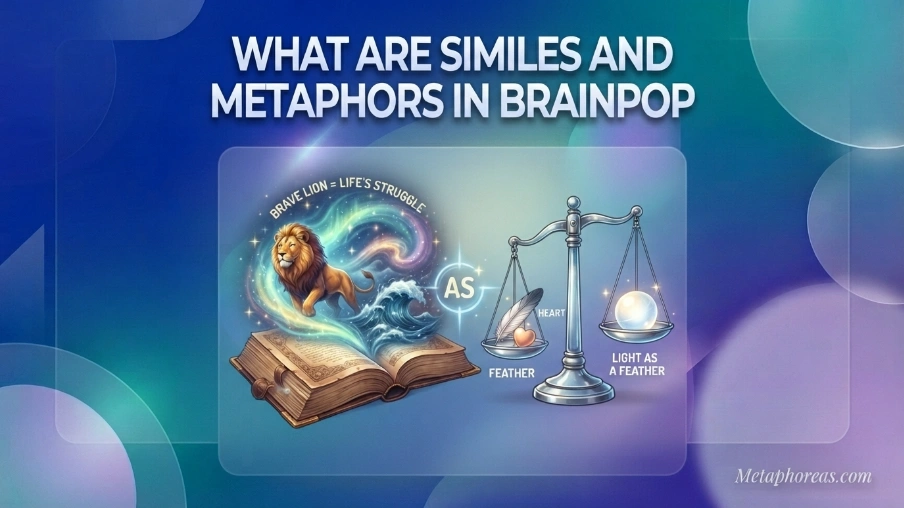
Similes and metaphors are figurative language tools that compare one thing with another to create a clearer picture or stronger idea. A simile uses “like” or “as,” while a metaphor makes a direct comparison without those words. BrainPOP teaches these comparisons through simple examples that help students understand meaning and imagery.
Simile
A simile compares two different things by using like or as.
For example:
Her smile was like sunshine.
A smile cannot literally be sunshine. The comparison tells us that her smile was bright, warm, or cheerful.
Metaphor
A metaphor also compares two different things, but it does so directly.
Her smile was sunshine.
The person is not actually made of sunshine. The metaphor creates a strong mental picture by connecting her smile with warmth and happiness.
Quick Comparison
| Feature | Simile | Metaphor |
|---|---|---|
| Main purpose | Makes a comparison | Makes a comparison |
| Uses “like” or “as” | Usually yes | Usually no |
| Example | He runs like the wind. | He is a rocket. |
| Effect | Clear and easy to spot | Often stronger or more imaginative |
| Common in | Stories, poems, speech | Stories, poems, speech, everyday language |
BrainPOP’s educator materials describe the lesson as a way for students to learn how similes and metaphors can bring language to life and create pictures out of words.
Why Do We Use Similes and Metaphors?
People use these comparisons because plain words do not always give readers enough to picture an idea.
Compare these sentences:
The hallway was noisy.
and:
The hallway was a buzzing beehive.
The second sentence gives you a much stronger image. You can almost hear the students talking and moving around.
Similes and metaphors can help writers:
- Describe people and places
- Show feelings
- Make stories more interesting
- Create pictures in the reader’s mind
- Make poems more memorable
- Explain difficult ideas
- Add personality to everyday speech
They also appear outside school. You may hear someone say, “I’m as busy as a bee,” or “My phone is a lifeline.”
The comparison carries extra meaning without requiring a long explanation
Here are practical examples similar to the kind of comparison students learn when studying figurative language.
1. As busy as a bee — Simile
This means someone is very busy and active.
Sentence: Maya was as busy as a bee before the party.
Tone: Informal
2. He is a lion — Metaphor
The person is compared directly to a lion to show courage or strength.
Sentence: During the emergency, Carlos was a lion.
Tone: Neutral
3. Cold as ice — Simile
This describes something extremely cold.
Sentence: My hands were as cold as ice.
Tone: Informal
4. The classroom was a zoo — Metaphor
The classroom is compared with a zoo because it is loud, crowded, or difficult to control.
Sentence: After lunch, the classroom was a zoo.
Tone: Informal
5. She sings like a bird — Simile
The comparison suggests that her singing is pleasant or beautiful.
Sentence: Ava sings like a bird.
Tone: Neutral
6. His words were arrows — Metaphor
The words are compared with arrows to show that they hurt someone emotionally.
Sentence: His words were arrows aimed at her confidence.
Tone: Formal
7. Fast as lightning — Simile
This means something happens extremely quickly.
Sentence: The runner was as fast as lightning.
Tone: Informal
8. My brother is a rock — Metaphor
A rock represents strength, reliability, or emotional support.
Sentence: My brother is a rock when I need help.
Tone: Neutral
9. Her eyes sparkled like stars — Simile
The comparison creates an image of bright, lively eyes.
Sentence: Her eyes sparkled like stars when she opened the gift.
Tone: Neutral
10. The city is a jungle — Metaphor
The city is compared with a jungle to suggest noise, competition, or confusion.
Sentence: After moving downtown, he felt the city was a jungle.
Tone: Informal
11. Quiet as a mouse — Simile
This describes someone or something making very little noise.
Sentence: The children were quiet as mice during the test.
Tone: Informal
12. Time is a thief — Metaphor
Time is compared with a thief because it seems to take moments away.
Sentence: Time is a thief when you are having fun.
Tone: Neutral
13. She was like a ray of sunshine — Simile
This suggests that someone brings happiness or warmth.
Sentence: Her friendly greeting was like a ray of sunshine.
Tone: Neutral
14. His heart is stone — Metaphor
The metaphor suggests that someone seems cold or without sympathy.
Sentence: After the argument, she felt that his heart was stone.
Tone: Formal
15. Strong as an ox — Simile
This describes someone who is very strong.
Sentence: Grandpa is as strong as an ox.
Tone: Informal
16. The baby is an angel — Metaphor
The baby is compared directly with an angel to suggest sweetness or good behavior.
Sentence: After falling asleep, the baby was an angel.
Tone: Informal
17. Her voice was like velvet — Simile
Velvet suggests softness, smoothness, and comfort.
Sentence: Her voice was like velvet during the song.
Tone: Formal
18. Fear is a shadow — Metaphor
Fear is compared with a shadow because it can follow someone.
Sentence: Fear became a shadow that followed him everywhere.
Tone: Formal
19. The water shone like glass — Simile
The comparison suggests that the water looked smooth and reflective.
Sentence: At sunrise, the lake shone like glass.
Tone: Neutral
20. My desk is a disaster zone — Metaphor
The desk is compared with a disaster area because it is extremely messy.
Sentence: After studying all night, my desk was a disaster zone.
Tone: Informal
21. As light as a feather — Simile
This means something weighs very little.
Sentence: The package was as light as a feather.
Tone: Neutral
22. Knowledge is power — Metaphor
Knowledge is directly connected with power because it can help people make better choices.
Sentence: Her teacher reminded her that knowledge is power.
Tone: Formal
23. He fought like a tiger — Simile
The comparison suggests determination, energy, or bravery.
Sentence: He fought like a tiger to win the final match.
Tone: Neutral
24. The news was a bomb — Metaphor
The metaphor suggests that the news caused sudden shock.
Sentence: The announcement was a bomb for the entire team.
Tone: Informal
25. Busy like a bee — Simile
This gives a lively picture of someone working constantly.
Sentence: Mom was busy like a bee getting everything ready.
Tone: Informal
26. Her laughter was music — Metaphor
The metaphor suggests that her laughter sounded pleasant.
Sentence: Her laughter was music to everyone in the room.
Tone: Neutral
27. The wind howled like a wolf — Simile
The comparison helps the reader imagine the sound of strong wind.
Sentence: The wind howled like a wolf outside the window.
Tone: Neutral
28. His mind is a computer — Metaphor
This suggests that someone remembers, processes, or organizes information very well.
Sentence: His mind is a computer when it comes to numbers.
Tone: Informal
Quick Reference Table
| Expression | Meaning | Type | Tone |
|---|---|---|---|
| As busy as a bee | Very busy | Simile | Informal |
| He is a lion | Brave or strong | Metaphor | Neutral |
| Cold as ice | Extremely cold | Simile | Informal |
| Classroom was a zoo | Very noisy or chaotic | Metaphor | Informal |
| Sings like a bird | Beautiful singing | Simile | Neutral |
| Words were arrows | Words caused pain | Metaphor | Formal |
| Fast as lightning | Very fast | Simile | Informal |
| Brother is a rock | Reliable support | Metaphor | Neutral |
| Eyes like stars | Bright eyes | Simile | Neutral |
| City is a jungle | Difficult, crowded place | Metaphor | Informal |
| Quiet as a mouse | Very quiet | Simile | Informal |
| Time is a thief | Time takes moments away | Metaphor | Neutral |
| Like sunshine | Brings happiness | Simile | Neutral |
| Heart is stone | Emotionally cold | Metaphor | Formal |
| Strong as an ox | Very strong | Simile | Informal |
| Baby is an angel | Sweet or well behaved | Metaphor | Informal |
| Voice like velvet | Soft and smooth | Simile | Formal |
| Fear is a shadow | Fear follows someone | Metaphor | Formal |
| Water like glass | Smooth and reflective | Simile | Neutral |
| Desk is a disaster zone | Extremely messy | Metaphor | Informal |
| Light as a feather | Very light | Simile | Neutral |
| Knowledge is power | Knowledge gives ability | Metaphor | Formal |
| Fought like a tiger | Fought bravely | Simile | Neutral |
| News was a bomb | Very shocking news | Metaphor | Informal |
| Busy like a bee | Very busy | Simile | Informal |
| Laughter was music | Pleasant laughter | Metaphor | Neutral |
| Wind like a wolf | Strong, eerie sound | Simile | Neutral |
| Mind is a computer | Very good at processing information | Metaphor | Informal |
Real-Life Conversations
Casual Conversation
Mia: How was your first day at the new school?
Jake: Crazy. The hallway was a zoo between classes.
Mia: I can imagine. Was your teacher nice?
Jake: Yeah. She was as calm as a lake even when everyone was talking.
Mia: That sounds like a good teacher.
Jake: She really was.
Professional Conversation
Manager: How did the presentation go?
Daniel: Better than I expected. The client’s questions came like a storm, but the team handled them well.
Manager: Good. How did Sarah respond?
Daniel: She was a rock. She stayed calm and answered every question clearly.
Manager: Excellent. That kind of confidence helps during difficult meetings.
Everyday Usage
You do not need to be writing a poem to use figurative language.
In conversation, people often use familiar comparisons without thinking about them. Expressions such as “busy as a bee,” “cold as ice,” and “time is flying” sound natural because listeners already understand the picture.
On social media, similes and metaphors can make short posts feel more personal. Someone might describe a vacation as “a dream” or say the sunset looked “like a painting.”
In school writing, these comparisons can also help a description feel less flat. The key is to choose an image that actually fits the idea.
Common Mistakes
| Mistake | Reason | Correct Version |
|---|---|---|
| Calling every comparison a simile | Similes have a recognizable comparison pattern | Check whether like or as creates the comparison |
| Thinking every sentence with “like” is a simile | “Like” can have other grammatical jobs | Ask whether it actually compares two things |
| Taking metaphors literally | Figurative language creates an image | Look for the intended idea |
| Mixing unrelated metaphors | Conflicting images can confuse readers | Keep the comparison logical |
| Using too many comparisons | Too many images can weaken the writing | Choose the strongest comparison |
| Writing “She is like a rose” as a literal fact | The sentence compares her with a rose | Explain the quality being suggested |
| Assuming metaphors must use “is” | Metaphors can take many forms | Look for the direct comparison |
A useful classroom habit is to ask one simple question: What two things are being connected, and why?
That question often reveals the meaning faster than looking for a single grammar rule.
Related Terms
Similes and metaphors belong to the larger family of figurative language, but they are not the only devices students may encounter.
| Term | What It Does | Example |
|---|---|---|
| Simile | Compares using like or as | Her smile was like sunshine. |
| Metaphor | Makes a direct comparison | Her smile was sunshine. |
| Personification | Gives human qualities to something nonhuman | The wind whispered. |
| Idiom | Uses a familiar phrase with a nonliteral meaning | Break a leg! |
The biggest distinction is that a simile openly signals its comparison, while a metaphor presents the connection more directly.
Frequently Asked Questions
Is BrainPOP good for learning similes and metaphors?
Yes. BrainPOP’s educator materials specifically use the Similes and Metaphors movie as part of lessons where students identify comparisons and interpret their meanings. The accompanying activities can move students from watching and learning toward applying the idea in their own writing.
What grade level is the BrainPOP similes and metaphors lesson for?
BrainPOP materials use the lesson across different instructional settings. A Grade 4 essential-skills guide lists Similes and Metaphors as a resource for identifying and interpreting these comparisons, while an eighth-grade lesson plan also includes the movie and related activities.
What is the easiest way to find a simile?
Look for a comparison that uses like or as, then check whether the words connect two different things. For example, “The snow was like sugar” compares snow with sugar. The word “like” alone does not guarantee a simile, so always check the meaning of the whole sentence.
Can a sentence contain both a simile and a metaphor?
Yes. A writer can use different forms of figurative language close together. For example, “Her voice was music, and it flowed like a gentle stream” contains a metaphor followed by a simile. Good writing uses each comparison for a clear purpose rather than adding them simply for decoration.
Why do teachers ask students to interpret metaphors?
Finding the comparison is only the first step. Students also need to understand the quality or feeling behind it. If a writer calls someone “a rock,” the reader should think about qualities such as strength, dependability, or support instead of imagining an actual stone.
Are common phrases such as “time is money” metaphors?
Yes. “Time is money” is commonly treated as a metaphor because it directly connects time with money to express its value. It does not mean that hours are literally dollars. The comparison helps communicate the idea that time should be used carefully.
Can metaphors be used in formal writing?
They can, as long as the comparison is clear and appropriate for the subject. A carefully chosen metaphor can make an explanation memorable or help readers understand an abstract idea. In formal writing, avoid slangy or confusing comparisons that may distract from the main point.
What should I do after learning similes and metaphors?
Try creating your own comparisons. Start with something familiar, such as rain, school, friendship, fear, or happiness. Write one simile and one metaphor about it. Then ask whether each comparison creates a clear image and whether the connection makes sense.
Final Thoughts
Learning similes and metaphors becomes much easier when you stop treating them as rules to memorize and start seeing them as pictures made with words. A simile usually signals its comparison with like or as, while a metaphor creates the connection more directly. BrainPOP uses this idea in an approachable lesson that helps students recognize and interpret figurative language. Once you can spot the comparison and explain the idea behind it, you can begin using your own images to make writing clearer, stronger, and more memorable.
Discover More Post
28+Surfing Metaphors Meaning Examples and How to Use Them Naturally 2026
Metaphors About Water Meaning Examples and Everyday Use 2026

Moryn is the lead writer at Metaphoreas with 6+ years of experience in English language education and digital content writing. Passionate about making complex language concepts simple, Moryn creates well-researched articles on metaphors, idioms, figurative language, and everyday expressions. Every guide is written with accuracy, clarity, and the reader’s learning experience in mind. Through Metaphoreas, Moryn aims to help learners, writers, and students master English with confidence.